Let’s Tweak the 5E Ranger

I really enjoy the new Fifth Edition of Dungeons & Dragons (5E). I think it strikes a really nice balance between crunchy rules for the players to latch onto and enough guidelines and fluff to allow the DM to control and alter the story without the session feeling like an extended board game. I like the fact that the designers are playtesting more before they release things, and that really shows in the classes. Each class feels balanced against each other but in ways that allows each to shine with something that no one else can do.

Except the ranger. The ranger feels like a throwback to the oldest edition of the class where it was a Frankenstein-like amalgamation of other classes. The ranger in 5E doesn’t do anything noteworthy that some of the other classes can’t accomplish with their existing abilities. It has a few cool abilities that really add to the flavor, but the other classes have that as well – and then some.

Mike Mearls stated a short while ago that they feel the ranger may have missed the mark with some players and that they were going to be looking at revising it in the future. Likely this means we’ll see some variation of it in an upcoming Unearthed Arcana article, but I’m pretty impatient. I wanted to see if I could put together a revised ranger that met my goals for the class while trying to keep the design aesthetics of 5E. So I tweaked it, pretty extensively actually as you will see.

My goals with tweaking the ranger came from the following thoughts.

  • The Hunter archetype has abilities that ALL rangers should have. The Beast Master archetype is neat, but when compared to the Hunter it falls waaaay short.
  • Spellcasting should be an OPTION for the ranger, not the default class. And I feel having a separate spell list is redundant – the Venn diagram between ranger and druid spells overlaps so much as to make a separate list moot.
  • Rangers should be mobile and focus on surgical strikes against foes. The exact details of this should be left to the individual ranger.

Looking at the existing ranger, I made the following major changes to the new one.

  • I removed spellcasting as the default option and replaced its abilities with Wilderness Boons. These are spell-like abilities that can be used outside of combat once per long rest to duplicate the utility aspects of the ranger’s spell list.
  • I gave them a unique ability called Mark, which scales in level in a similar fashion to sneak attack, that otherwise functions just like the hunter’s mark spell.
  • I moved the Hunter archetype abilities into a category called Tactical Tricks that the ranger can select at various levels. These are things that ALL rangers should have the option of doing, which includes some defensive and offensive abilities that are more situational.
  • I developed three archetypes – the Beast Master, the Stalker, and the Wild Guardian. The Beast Master functions very similarly to the existing Beast Master archetype, with some noteworthy differences (commanding your beast to attack is a bonus action, for example, and at 15th level your beast becomes bigger and better). The Stalker gets some of the more stealthy abilities of the original ranger class, and the Wild Guardian is essentially a druidic version of the fighter’s Eldritch Knight with some terrain-based abilities.
  • I beefed up the 20th level ability to make it more of a “wow” feature, like the rest of the classes.

Take a look at the PDF and let me know what you think. I’ll be playtesting this with my own home group as well to see how it balances out.

THE RANGER Modified

Kickstarter Campaign is LIVE!

https://www.kickstarter.com/projects/weirddave/fantasy-renaissance-adventure-modules

Check it out! If it’s something that you seem interested in, give us a pledge and spread the word. I’m very excited to be finally launching this campaign – it seems like years ago when I first decided to strike out on my own and publish my own adventures. Earlier this year I took the actual steps of starting the company and pulling together the first module, getting it written, edited, laid out, and art assets pulled together. It took longer than I wanted, but I learned a lot, which has helped put a realistic delivery date on the campaign (December 2015). I’m HOPING for earlier, but I figured it best to underpromise and overdeliver. I know I’ve been burned by a few Kickstarters over the past few years, and I think everyone who has pledged on the crowdfunding platform has horror stories of their own.

I’m dedicated to making sure mine doesn’t become one of those, but instead one that help restore some confidence in the Kickstarter platform, even if only a little bit. So take a look, spread the word, and let me know if you have any questions. I’m around, constantly refreshing the page, likely for the next 30 days.

A Wee Bit Sad About Dragon Magazine

I know this isn’t news in any real sense, but maybe it’s just starting to hit me. Dragon Magazine has no place in the physical world anymore. There are no new issues coming out, filled with articles that I probably would never use but always enjoyed reading. Some part of me has felt compelled over the past few days to look back over my collection of Dragon Magazines and re-read them (or at least re-flip through them).

My history with Dragon Magazine certainly doesn’t go back as far as many people’s. The first issue I recall being exposed to was #234, “Beyond the Grave,” an October issue from 1996. The Hennepin County Library where we played AD&D after school had just got it in, and I remember devouring it’s contents very quickly. Many of the articles stand out as some of my favorites to this day – the Wyrms of the North entry about Daurgothoth the dracolich, a few kits for rangers, and an assortment of magical items designed for a lich. The comics were fantastic, the editorial was engaging, the forums and Sage Advice invaluable – it was a fantastic way to learn that there was this whole bigger world outside of my little town and gaming friends.

The first issue I purchased was #236, “Faith & Hope,” which again had a lot of really interesting articles. Then nothing. For months there was nothing, and then finally #237 came with the news that TSR, Inc. had been purchased by Wizards of the Coast. Quite a shock, but frankly from my small perspective it didn’t change much. The books kept getting published (after the hiatus with the company purchase) and things moved along. Dragon Magazines continued to flow and I would hunt down each one. (I admit, though, I never had a subscription – I had one for Dungeon Magazine, but never for Dragon. Weird.)

These physical issues that sit on my shelf are time capsules, able to whisk away the reader to a time nearly 20 years ago when the landscape for roleplaying was a bit different. I see mentions of Winter Fantasy in Milwaukee, with talks of the amazing dealer hall there and great times playing all sorts of games. I went to Winter Fantasy this year in February in Fort Wayne, IN. It was fun, yes, but it felt like little more than a small house con for the Adventurers League. No dealer hall. Not a lot of people. Essentially just a single hall in a much larger convention center.

I read about the products that TSR/WotC were putting out, and I remember drooling with anticipation about them. Adventures, novels, sourcebooks – it was all ripe for the plunder. I look at these magazines and I lament the fact that the last physically published issue of Dragon Magazine was #359 in September 2007 – about 10 years and 123 after I started reading. I have most of those 123 issues (there’s a few gaps here and there but not many) and I have no desire to get rid of them.

Dragon Magazine (and Dungeon) moved to an online only format after #359, and with that my interest in it waned completely. Part of it was definitely 4th Edition, which did not attract me in any meaningful way, but I feel if they kept putting it out as a physical magazine I would keep buying it. I understand the realities of print runs, costs, editorial staff, etc., etc., all the real things that meant an electronic path was a prudent one.

But I can still lament the loss of such a titan in the industry, and be a wee bit sad that we have had nothing to really fill its hole.*

* Not quite nothing, of course. Gygax Magazine has come up in the past two years to take the place of the missing Dragon, and I enjoy those issues dearly (and have even contributed an article to it!). However, Gygax Magazine has been plagued with late deliveries, and though I plan on purchasing every issue I can find whenever they come out, anticipating their release has become a bit of a fool’s errand. Issue #6 is the next one, and by all accounts it appears nearly finished – and I’ll be lining up to purchase it as soon as it’s available!

A Look Behind and (Slightly) Ahead

I am planning on launching the Kickstarter for the Fantasy Renaissance Adventure Modules very soon. Like, super soon. OK, I’ll put a date to it – Monday, August 17th! But it’s probably a good idea to look at why I’m doing a Kickstarter and what I’m hoping to do with it.

I don’t think I could be a smaller operation. Cut to the Chase Games is pretty much just me and my super supportive fiance trying to bring awesome adventures to the gaming scene. And I want them in print as well, so that’s added a challenge that’s been interesting to figure out (and frankly I’m still figuring out some distribution parts, but that’s for down the road a bit). I’ve been writing adventure modules for nearly as long as I’ve been playing roleplaying games – my home games I wrote out, poorly to be honest, but I wrote in the style of a Dungeon Magazine scenario so that I didn’t have to remember them when I was playing and I didn’t have to read my poor scribbled handwriting.

So I’ve built up quite a catalog of awesome adventure ideas and possibilities, but what to do with them? I read the adventures in Dungeon Magazine, and finally in 2005 I submitted a handful of proposals to them (Paizo was handling both Dragon and Dungeon at the time). They liked one of them, “Heart of Hellfire Mountain”, and asked that I send it in. I did, eagerly, and then waited quite awhile for anything to come of it. I submitted more proposals in the meantime, and got a few rejections back with critical feedback, but quickly I stopped getting responses at all. So did everyone else it seemed.

I got word sometime in late Q2 2006 that my adventure was slated for Dungeon Magazine #140, and around that same time came the announcement of Dungeons & Dragons 4th Edition. Wizards was ending the contract with Paizo and bringing Dragon and Dungeon magazines in house, and Dungeon #150 was going to be the last. Well, that explained the lack of responses! Dungeon #140 came out, and the cover featured the archdevil Mephistopheles from my adventure (“Heart of Hellfire Mountain” for 20th-level characters!). I was super excited and hungry for more, but with the flux of the game it seemed as though things were moving inward rather than outward. I feel like if I had jumped at submitting proposals earlier I might have been able to establish myself in Dungeon Magazine better, but ah well. No complaints, no regrets, keep moving forward!

I kept my eye on sources, and my love of the pulp 1930’s gaming genre brought the Ravaged Earth setting and Savage Worlds system to my attention. I think it was GenCon 2007 (maybe?) that Reality Blurs released the print version of Ravaged Earth, and I left Minnesota on Friday after work to drive through the night to Indianapolis just so I could get a copy. (That’s a story for another time – a harrowing journey to be sure!) I got it, read it, and then reached out to Reality Blurs with a handful of One Sheets (short Savage Worlds scenarios meant to be played in just an hour or two) I wrote. Sean Preston got back to me and I hit the ground running with some projects for them. I had a lot of fun writing for Reality Blurs, and massaged some of my backlog of fantasy adventures into the Old School Fantasy series (Hunger of the Iron Mage, Call of the Crow, and Slave Pens of Moss Stone were my favorites).

Eventually I parted ways, amicably, with Reality Blurs and focused on personal things. I always had the idea in the back of my head of trying to release trilogies of adventures, each that could be run individually but together would form a mini-arc. Dungeon Magazine explored the idea a handful of times, and I always found it more digestible than the sprawling adventure paths they focused on instead.

Fast forward a bit to 2014, and the company I worked for announced they were moving to Colorado. For various reasons I decided to stay in Minnesota and was kept on until the end of Q1 2015 to help with the transition. I don’t know if I could get a stronger sign, so I decided to take the leap into game design company ownership and started up Cut to the Chase Games in January 2015. I’ve learned a lot since then, registering things and purchasing things and learning new technologies, but it’s all led to the launch of the Fantasy Renaissance Adventure Module Kickstarter campaign.

Where does it go from there? I hope it keeps going, and I hope I get to fully realize the backlog of adventure titles I’ve got (there are more than 30 of them with titles, outlines, and ideas, and more than twice that with just one of those three things!). But only time will tell.

GenCon 2015 Wrap-Up

GenCon 2015 was a great success! Cut to the Chase Games had a handful of games on the schedule, and they went swimmingly (except for the third one – I think there was a mixup on my DM dashboard – see below). I didn’t have any products to showcase so no booth or anything fancy like that, but I sure spent a lot of my time gaming it down with lots of terrific folks!

I had three sessions for Cut to the Chase Games on the books – TG1 Lost Temple of IbholthegTG2 Tongues of the Screaming Toad, and TG3 Shadow Out of Sapphire Lake, along with a pile of Adventurers League games for Baldman Games. Let’s look at each one.

TG1 LOST TEMPLE OF IBHOLTHEG
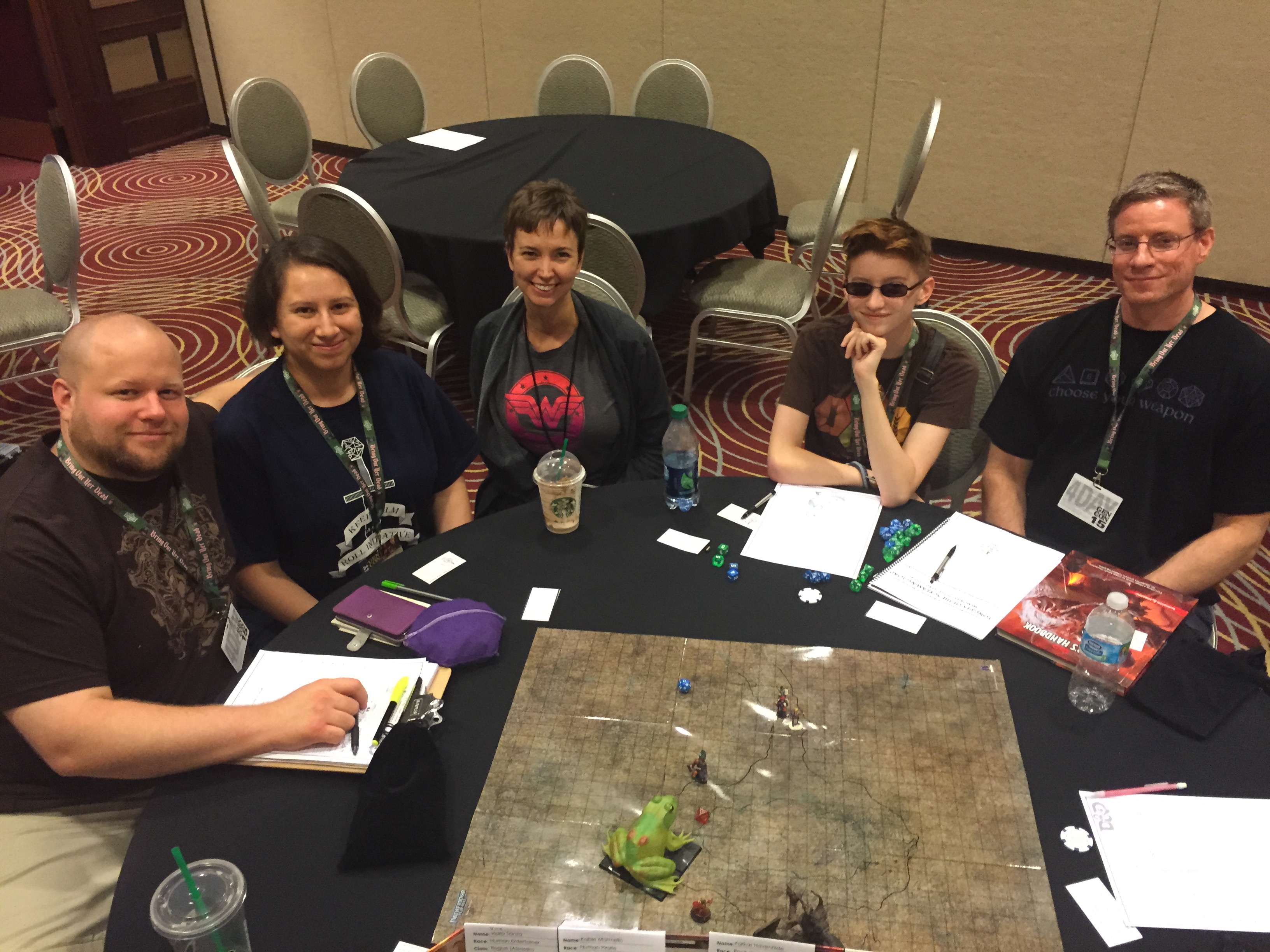
I had a great table of players for the inaugural run of TG1 and, though we didn’t finish (the modules are not meant for 4 hour slots!) we all had a lot of fun and got past the titanic toad that guards the temple. Here’s the pic of the players at the end of the session. Great people, and some Minnesota boys to boot!

IMG_0314

TG2 TONGUES OF THE SCREAMING TOAD
I was perhaps most worried about this one, because it’s a bit of a mystery to begin with, which is always tricky to pull off. Who knows if the players are going to pick up on the bits, or if I’m going to have to push them? Thankfully, the table was another set of FANTASTIC players and they all got into it quite well. So much fun. Again, we didn’t finish – but we got past the mystery part, so that made me quite happy.

IMG_0315

TG3 SHADOW OUT OF SAPPHIRE LAKE
So this one was my middle game on Friday, and in retrospect I think there was a mistake on my DM dashboard at GenCon. I was sitting in my room, nearly alone, waiting for players to show up. Nothing! I figured it’s GenCon, people get busy and can’t make it to games, but to have no one show up? Pretty strange. Afterwards, I investigated and found that my dashboard sent me to the wrong Indiana ballroom. Blergh. So no TG3 players or pics. Sad face.

ADVENTURERS LEAGUE GAMES
I really enjoy judging for Baldman Games – last year was my first year EVER running a game at GenCon, and it was for Baldman running new games of 5th Edition. I had so much fun I ran Adventurers League games at Gamehole Con in November in Madison, Winter Fantasy in Fort Wayne in February (sucky drive!), and Origins in Columbus in June. Next year? I’m hoping I’m going to have my hands full of Cut to the Chase Games slots but who knows? The Epic on Saturday night was fantastic – I got to run the Tier 3 table (12th level average party) and the players really got into the swing of things down in the bowels of the hedonistic fire giant city, tearing it up with colossal gladiators in a coliseum of blood and terror.

My view for most of GenCon

My view for most of GenCon

GenCon is such a whirlwind of movement, people, sights, and sounds that it can be quite overwhelming. I also learned earlier in the year that 7 sessions (or roughly 30 hours) of ANYTHING at a convention is my limit – I get worn down and my voice goes bye-bye otherwise.

What does the future hold? Hopefully nothing but awesome things for everyone! Game on!

WK0 Released to the Wild!

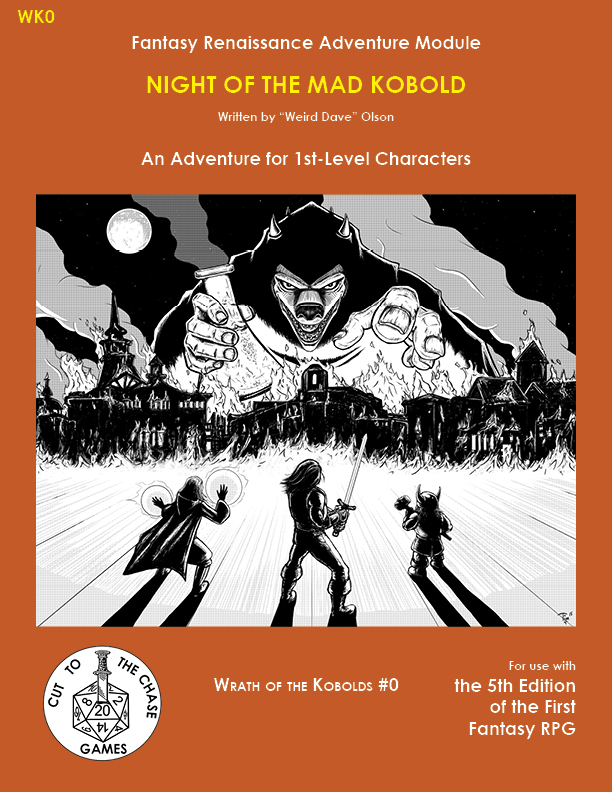
The first product released by Cut to the Chase Games, WK0 Night of the Mad Kobold is now available FOR FREE! You can get it in one or more fine flavors – 5E, Pathfinder, Swords & Wizardry, or Savage Worlds. Tim Wilsie did the cover art, Kelly Christensen did the editing, and I did the writing. It was a lot of fun to put together, and can be playable in a single evening – or stretched out if you want to prolong the kobold bomber’s mad night of terror into a weekend thing.

WK0_5E_Cover

But get this adventure quick, cause after the Kickstarter for the Fantasy Renaissance Adventure Modules is done (launching in mid August) the price goes up to $3.00.

Get them here!

5E version
Pathfinder version
Swords & Wizardry version
Savage Worlds version

Handy Printable Form Fillable PC Reference Cards!

The Adventurers League had a nice post about using Inspiration, a mechanic in 5th Edition. It’s something I rarely remember, but mainly because it’s quite a lot of work to write down and remember everyone’s details at a convention table. But I liked the idea, and put together a quick PDF that can be used to hang on a GM screen that contains the key information. Check out my 5E PC Reminders and let me know what you think!

The sheet is designed so you just have to print it out and make two cuts – one horizontal and one vertical. There shouldn’t be any paper wasted. Make sure to select the Actual Size option when you print in Adobe Acrobat (rather than Fit).

One note – I wish I had a separate spot for Background, as I think that is an important aspect of a character, so I what I’ve done is put it into the Race field (so it would say Human Pirate or Hill Dwarf Criminal).

Randomness is Inspiration

I’m a big fan of random tables. I always have been – there’s something about having a table of possible results but not knowing exactly what the result is going to be that really appeals to me as both a writer and a designer. Many adventures in the Cut to the Chase Games backlog, or at least the seeds of those adventures, were generated using some combination of random tables. I’ve created whole random adventure generators for AD&D 2nd Edition, ones that I cringe over now but I still pull out every now and then to look over fondly.

For me, a random table is a good way to jump start inspiration. If I’m given some crazy elements and told to make a scenario out of it, my mind begins to work to try and stretch the fantastic to encompass some sort of plausible set of adventure parameters. This is one of the many reasons I fell in love with the 5th Edition Dungeon Master’s Guide. Appendix A: Random Dungeons is a literal treasure trove of possibilities. I know it pulls a lot of inspiration from the 1st Edition DMG but that’s not the one I grew up with – I grew up with the AD&D 2nd Edition books, and random tables seemed relegated to the treasure tables and that was it.

But then the Dungeon Builder’s Guidebook came along. It used geomorphs for the random maps, something that never appealed to me, but it came with a lot of really fun tables for random traps along with one of my all time favorite tables for adventures – the random dungeon premutation table. This table was a list of big, thematic changes that could be made to a dungeon setting to make it unique. I still refer to this table from time to time to get inspiration when the well feels a little dry and so far it hasn’t failed me.

All this talk of random tables has put me in the mood to roll some dice. Excuse me while I bust out my Dungeon Master’s Guide and throw a little adventure together!

What I’m Reading

Over the past … umm … decade or so, I’ve let my reading habits slide. When I was much younger, I read avidly though nothing of particular note. I got my hands on The Hobbit in 5th Grade and quickly moved on to the whole Lord of the Rings trilogy, which formed a nice fertile bed for an imagination steeped in fantasy to flourish. Roleplaying games – AD&D 2nd Edition specifically – came naturally out of that bed, and with it came the novels. The Dragonlance Chronicles Trilogy had me hooked from the opening page, and I loved every word in those books.

Somewhere in there, I don’t exactly recall when, my family and I came upon a garage sale in a town just north of us (Maple Plain). There, someone had decided to sell their entire collection of Forgotten Realms and Dragonlance novels for $0.50 each. A steal! I used up my own meager funds quickly and begged my parents to help with the rest, which they graciously did. A vast collection of novels flooded into my hands, most of which were Forgotten Realms but a few older Dragonlance novels as well in there.

The first trilogy I read from that pile was the Moonshae books by Douglas Niles (Darkwalker on Moonshae, Black Wizards, and Darkwell) which I believe I grabbed because they were the “first” set when you look at the books in chronological order, though I knew that the novels didn’t tie into one another beyond the shared setting. They were fantastic novels and a good introduction to the Forgotten Realms on a whole, but to be honest? I don’t remember a lot of details about them at this point.

What I do remember is the second trilogy I devoured – the Icewind Dale Trilogy, R.A. Salvatore’s first Forgotten Realms novels and the introduction of great, timeless characters. Drizz’t Do’Urden, Wulfgar, Catti-Brie, Regis, and Bruenor Battlehammer. The Dragonlance novels had the Companions of the Lance, and they were very interesting and well thought out, but here Salvatore had created a party of characters that wore their D&D origins on their sleeves. The Crystal Shard, Streams of Silver, and The Halfling’s Gem were pure joys to read and set me upon my path as a devout Forgotten Realms fiction fan.

I think I picked up the Dark Elf Trilogy as the books were released, or maybe just after – I don’t recall, but those were also fantastic, telling of Drizz’t’s Menozoberranzan upbringing, years in the Underdark, and how he came to Icewind Dale. I couldn’t get enough of them, and as Salvatore wrote follow-ups to his original trilogy – The Legacy, Starless Night, Siege of Darkness, etc. – I kept up pace. But then something happened. I think it was the release of D&D 3rd Edition and my leaving of high school, but I found I didn’t make as much time for fiction reading. I would still pick up the books, and tried to read sporadically, but it was as if that need was being fed by the plethora of game books that I picked up and the stories I wanted to tell with my friends. My reading habits slipped down into a slump until only recently.

Why do I mention this in a post about what I’m reading? I decided with the release of D&D 5th Edition that I would try to get back into the fiction line, especially since Forgotten Realms had become the setting for the Adventurers League (the organized play arm of D&D). Big things had happened in the Realms that I was pretty oblivious to – the War of the Spider Queen, so many more Salvatore novels, the rise of Netheril and the Shade, and the Spellplague just to name a few. But Wizards was releasing a series of bridge novels called The Sundering that I was hoping would explain a lot.

The first one, The Companions, was written by R.A. Salvatore, and I read it quickly. It was good and reintroduced Regis, Bruenor, and Catti-Brie in new ways as they figured out the world around them, and I felt their journey reflected my own in part. While I didn’t read the novels where these iconic characters had died, I knew that they must have over the intervening years. Their resurrection into the world hooked me again and I wanted to read more about their activities.

It took a while longer but I snagged Salvatore’s follow up trilogy in hardcover, the Companions Codex, and finally just a few days ago I picked up the first book to read, Night of the Hunter. It’s strange, to read about these characters that I haven’t followed for a decade or more, but there’s more than a small twinge of the familiar as well. Salvatore is still a fantastic writer but I sometimes feel he relies a bit too much on the reader’s familiarity with the D&D game. Oh well, makes it more exciting for me!

Break Up the Mega-Dungeon

I am a big fan of classic adventures with flavorful dungeons, insidious traps, and dangerous denizens. But one thing I do not enjoy is the concept of the mega-dungeon – a great sprawling complex filled with rooms and chambers, a map-makers worst nightmare.

For one, as a DM, they’re kind of a boring to run. Or at least they can quickly devolve into total dullness as you run out of ways to say “20 foot by 20 foot chamber” to make them interesting to the players. And you really need to have a player who loves mapping, or at least someone who is willing to step up and do it, to get the best benefit. I’ve found my players don’t enjoy mapping out a dungeon as they explore, and I can hardly blame them.

There are a lot of ways to spice up a mega-dungeon, but I think my favorite way is to break it up. Break up the mega-dungeon into smaller, digestible pieces that can each have a unique hook or flavor. For me, a dungeon with about 12 areas to explore and interact with is a pretty perfect number, maybe a few more depending on the scope and maybe a few less if the hook is served well.

As an example, I’ve had the Ruins of Undermountain boxed set for almost 20 years now. It’s cool, and the maps are mesmerizing, but it’s kind of … overwhelming? Underwhelming? I’m not sure. The hook is strong, everyone and their brother has heard about it, and it sits beneath a great metropolis. Lots of things to like about it but I’ve never gotten around to running it because it just presents such a slog of corridors and empty rooms.

But in the past few years I’ve been itching to drag it out and start taking chunks of the map and converting them into distinct dungeons of their own. Crazed gnome illusionist takes over a section? A cultist to a rat god calls swarms of rats to do his bidding? A cabal of assassins create a gauntlet of pain for new initiates? Those are the kind of ideas I can get behind, and each can live within a relatively small section of Undermountain.

I know a lot of mega-dungeons use the concept of floors and levels to attempt this, but from what I’ve seen and experienced this still doesn’t keep it down to a usable chunk in a reasonable amount of time. Though I have been itching to take a closer look at Castle of the Mad Archmage, and the Emerald Spire from Paizo seems like it strikes about the right balance for my taste. Especially since each level can be contained in a single foldout map!

I don’t think you’ll see a mega-dungeon from Cut to the Chase Games anytime in the near future. There are enough other ones out there to cater to that flavor, and like I stated it’s just not my cup of tea. And if it’s not something I would run, you can bet your bottom dollar it’s not something Cut to the Chase Games is going to make!